Module 5: Islamic Art
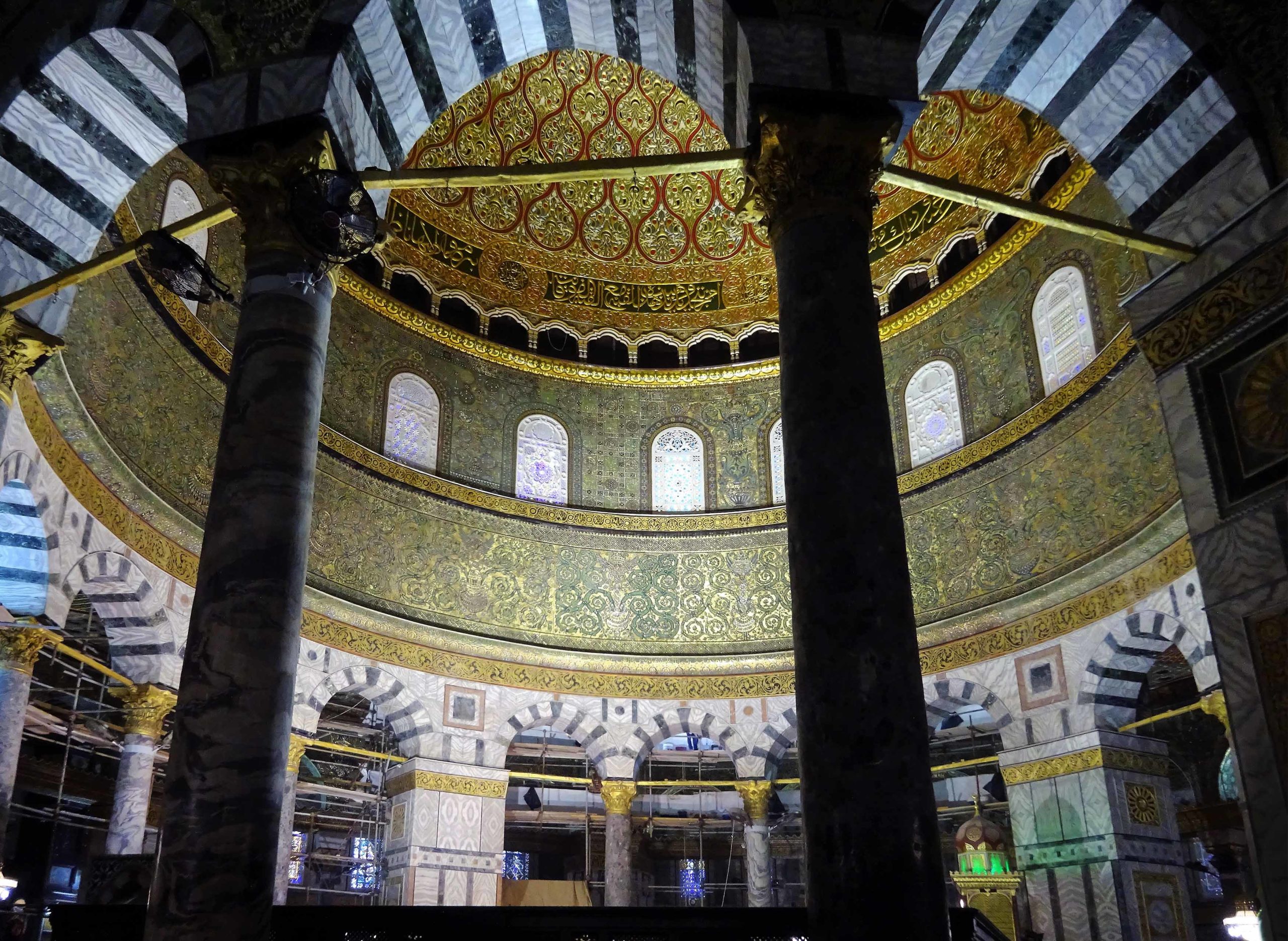
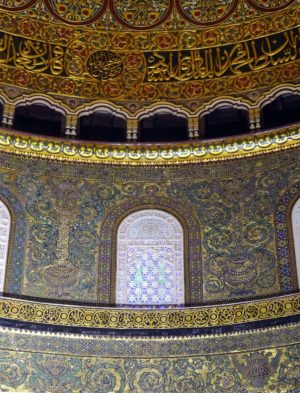
Interior view of the Dome of the Rock (Qubbat al-Sakhra), 691-92 (Umayyad), Jerusalem
The images above show the interior of the Dome of the Rock (Qubbat al-Sakhra), is an Islamic shrine that is on the Haram al-Sharif surrounded by many other religious buildings. The location is in the Old City of Jerusalem. The construction of the Dome was somewhere between 685 and 692 by a ruler named Abd al-Malik.
When looking at the interior, it's hard to miss the wall and ceiling mosaics. No humans or animals can be found in the mosaics, which is common in religious buildings and paintings. There is more use of symbols such as vegetation and winged crowns worn by kings. A lot of the symbols are from pre-Islamic civilization, such as the Sasanian Empire who was later conquered by the Arab armies.
In the center of the Dome of the Rock sits a large rock, which is presumably where the shrine got its name from. Many believe that this is where Abraham was to sacrifice his son in Abrahamic religions (Judaism, Christianity, and Islam). The walls surrounding the rock are truly enormous, as the dome is 20 meters (65.6 feet) in diameter which is supported by twelve columns. On top of that, there is a small chamber that is located underneath the Dome of the Rock with an unknown purpose.
The purpose and construction of the Dome of the Rock is under lots of speculation. It is believed that the architecture was derived from many other local churches/mosques. For example, the octagonal shape of the Dome's structure could be inspired from a 5th Century building: the Church of Kathisma.
As for the purpose of the Dome of the Rock, it is widely debated by scholars. Usually, dome shapes are seen in religious buildings as a representation of heaven or divinity. That could most likely be the purpose here, as along the wall is inscriptions of the Qur'an, shahada, and statements of Muhammad being the prophet of God.
Citations
Dr. Elizabeth Macaulay, "The Dome of the Rock (Qubbat al-Sakhra)," in Smarthistory, August 8, 2015, accessed September 26, 2021, https://smarthistory.org/the-dome-of-the-rock-qubbat-al-sakhra/.
Augustyn, A. (1998, July 20). Dome of the rock. Encyclopædia Britannica. Retrieved September 27, 2021, from https://www.britannica.com/topic/Dome-of-the-Rock.


Shawn, I really like the artwork you chose for this weeks blog. I think you organized your article well. The format makes it easy for readers to interpret the text and navigate through it. I think you could have expanded a little bit more on the purpose behind the Dome of the Rock that you said was under speculation. Adding a little more detail about the artwork will interest the audience and keep them engaged throughout the whole article. Overall nice work!
ReplyDeletei enjoyed this piece of art work I actually almost wrote about it aswell, you described it very well. i really enjoy how this art work has so many " could be's" it keeps everything interesting. very nice job this week
ReplyDelete